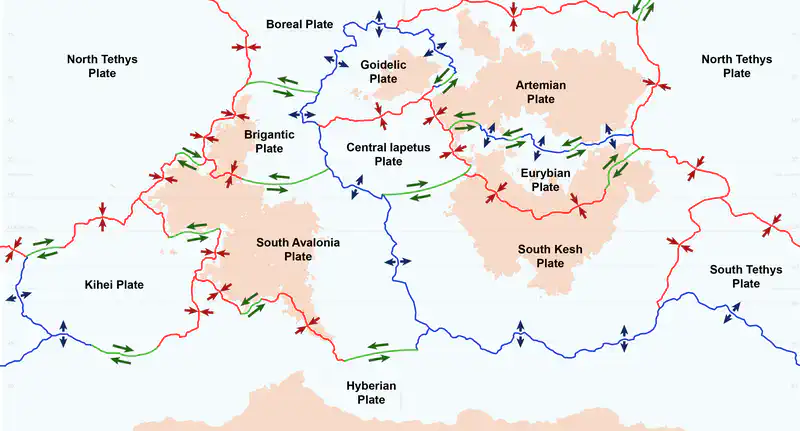
Understanding Plate Tectonics for Worldbuilding
When creating a new world, the foundation of your entire geographic system begins with plate tectonics. These massive segments of planetary crust don’t just move randomly—they dance to geological principles that have shaped Earth for billions of years.
Key Concepts in Plate Design
Convergent Boundaries
At convergent boundaries, where plates collide, we see the most dramatic geological features form:
- Mountain ranges
- Deep oceanic trenches
- Volcanic island chains
- Subduction zones
Divergent Boundaries:
These boundaries create:
- Mid-ocean ridges
- Rift valleys
- New crustal material
- Volcanic activity zones
Practical Application in Worldbuilding
1. Determining Plate Sizes
- Major plates: 30-60% of your world’s surface
- Minor plates: 10-30% of surface area
- Microplates: Small but crucial for local features
2. Movement Patterns
- Consider rotation points
- Account for momentum conservation
- Plan collision zones carefully
3. Feature Development
The interaction of plates leads to:
- Mountain range formation
- Ocean basin creation
- Volcanic arc development
- Continental drift patterns
4. Climate Implications
Mountain Effects
- Rain shadows
- Wind pattern disruption
- Altitude-based climate zones
- Weather barrier creation
Ocean Current Influences
- Warm and cold current patterns
- Coastal climate moderation
- Precipitation distribution
- Marine ecosystem development
5. Time Scales to Consider
Geological Epochs
- Short term: 10,000-100,000 years
- Medium term: 1-10 million years
- Long term: 100+ million years
Rate of Change
- Plate movement: 2-10 cm per year
- Mountain building: 0.5-1 cm per year
- Erosion rates
- Volcanic activity cycles
6. Advanced Considerations
Mantle Dynamics
- Hot spots and plumes
- Convection patterns
- Heat distribution
- Core-mantle interaction
Crustal Composition
- Continental crust (lighter, thicker)
- Oceanic crust (denser, thinner)
- Transitional zones
- Mineral distribution
7. World History Integration
Historical Impact
- Natural barriers affecting civilizations
- Resource distribution
- Trade route development
- Settlement patterns
Environmental Evolution
- Species distribution
- Habitat formation
- Resource availability
- Natural disaster zones
Common Worldbuilding Mistakes
Avoid these typical errors:
- Random mountain placement
- Illogical volcano distribution
- Inconsistent continental shapes
- Ignoring plate boundary effects
Advanced Considerations
Mantle Convection Patterns
When designing your world’s internal engine, imagine massive circular currents of semi-molten rock flowing beneath the crust. These patterns determine where your plates will naturally move - like conveyor belts, they’ll push continents apart at mid-ocean ridges and pull them together at subduction zones. For worldbuilding, this means plotting these flows first will help you determine natural plate movements and where major geological features might form.
Hot Spot Locations
Hotspots are stationary volcanic features that punch through whatever plate moves over them, like a blowtorch burning through moving paper. When plotting these on your world, remember they’ll create chains of progressively older features - like Hawaii’s island chain that spans thousands of kilometers. They can occur both in oceans and continents, creating features like Yellowstone or Réunion Island. For your world, these can create logical places for island chains or isolated volcanic regions that don’t fit the usual plate boundary patterns.
Triple Junction Points
These geological crossroads, where three plates meet, create some of the most dynamic and interesting regions on your world. The Afar Triangle in East Africa is a perfect example - here, three rifts are literally tearing a continent apart. When designing your world, triple junctions can be perfect locations for unique geographical features, from deep rift valleys to complex volcanic systems. They’re also natural locations for unique resources and challenging terrains that could influence your world’s civilizations.
Transform Fault Systems
Unlike the dramatic mountain-building of collisions or the rifting of divergent boundaries, transform faults are where plates slide past each other horizontally. The San Andreas Fault is the classic example - creating a line of seismic activity that shapes California’s geography and culture. In your world, these faults can create natural boundaries, influence river patterns, and create zones of frequent earthquakes that would affect how and where civilizations develop.
Technical Implementation
Method 1: Historical Evolution Approach (Starting from Ancient Past)
Start with a simplified supercontinent or early plate configuration (like Earth’s Pangaea) and work forward:
- Begin with 3-4 major landmasses
- Plot major divergent boundaries where your supercontinent will break
- Simulate 10-50 million years of movement at a time:
- Track continental drift paths (2-10cm per year)
- Note where fragments break off
- Mark where new ocean basins form
- Document the formation of:
- Mountain ranges from collisions
- Island arcs from subduction
- Rift valleys from separation
This method gives you a rich geological history and explains why features exist where they do, but requires more work to reach your desired configuration.
Method 2: Present-Day Reverse Engineering
Start with your desired current geography and work backwards to justify it:
- Draw your continents as you want them
- Identify major geological features:
- Mountain ranges
- Ocean trenches
- Volcanic regions
- Place plate boundaries to explain these features:
- Convergent boundaries along mountain ranges
- Divergent boundaries in oceans or rift valleys
- Transform faults where needed
- Verify that your plate system follows basic rules:
- Plates must form closed polygons
- Movement directions must be consistent
- Features should match boundary types
This method is faster and ensures you get the geography you want, but might require some creative explanations for unusual features.
Conclusion
A well-designed plate tectonic system provides the logical framework for your entire world’s geography. By understanding and implementing these principles, you create a foundation for believable landscapes that can support rich storytelling and immersive worldbuilding.
Further Reading:
- “Plate Tectonics: A Scientific Revolution” by Eldridge M. Moores
- “The Way the Earth Works” by Michael E. Wysession
- “Fundamentals of Geologic Mapping” by James H. Reynolds
Recommended Tools:
- GPlates for tectonic simulation
- QGIS for mapping implementation
- Wonderdraft for visual representation